RTP (return to player): what the percentage means — and what it doesn't
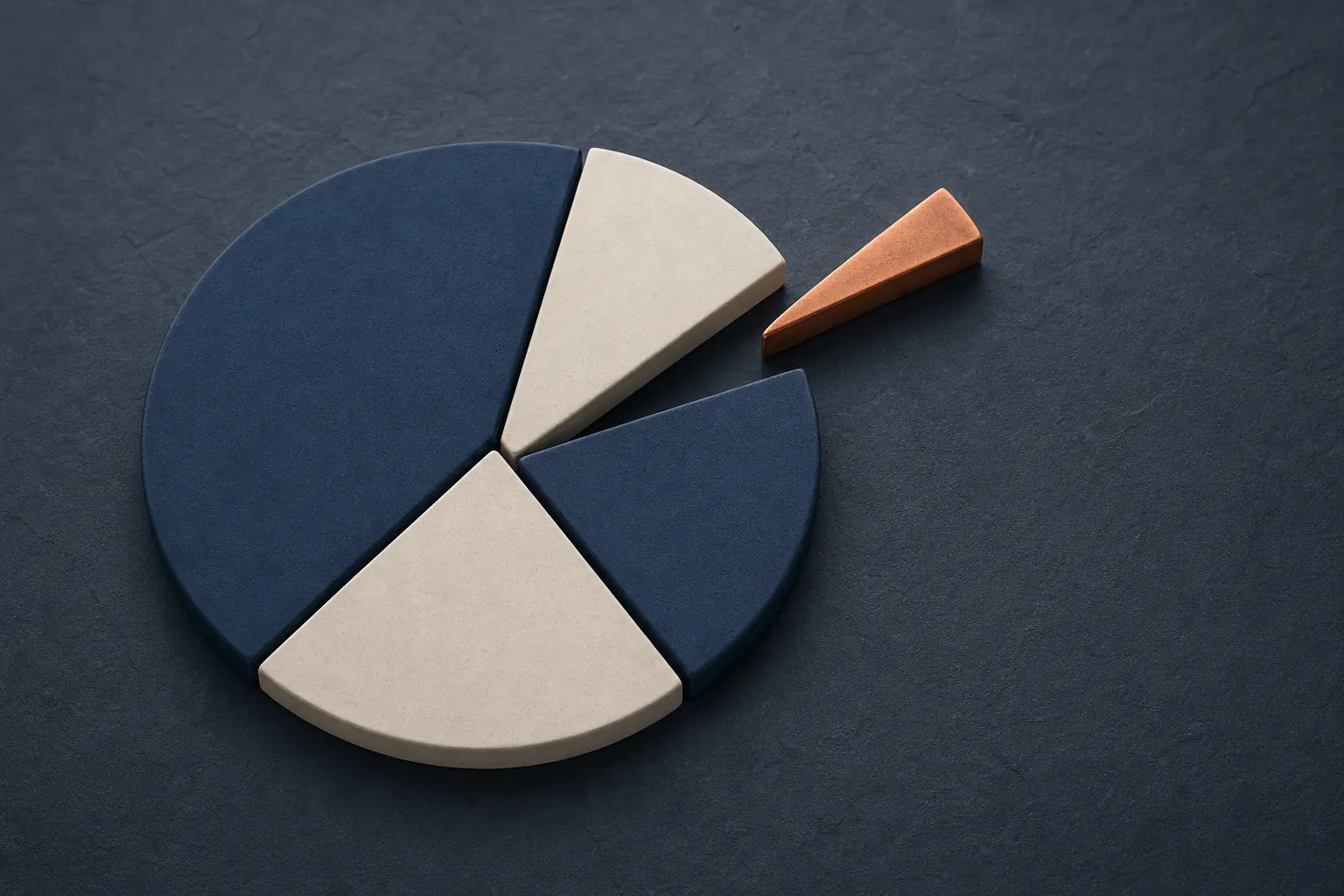
RTP is the percentage of all money staked on a game that the game is designed to pay back over a very large number of plays. A slot with 96% RTP keeps, on average, £4 of every £100 wagered — across millions of spins, by all players, over the game's life. It says almost nothing about the next hour.
Last reviewed: 21 September 2026 · Author: Eleanor Whitlock
The number is an average, not a promise
RTP is calculated from the game's maths model: every possible outcome, its probability and its payout, summed. The result is a theoretical figure. Actual returns converge on it only as the number of plays grows — and "grows" here means millions, not hundreds.
For a single session the spread around the average is enormous. On a high-volatility slot, a player can stake £200 and see £40 back, or £900 back, and both are perfectly ordinary outcomes for a game whose RTP is 96%. The percentage describes the pool, not the person.
Two consequences follow:
- RTP does not predict a session. Choosing a 96.5% game over a 95.5% game improves your long-run expectation by one penny per pound, which is real but invisible on any given day.
- RTP is not "due". A game that has paid little for an hour is not building up to a payout. Each spin is independent; the average is reached by the law of large numbers, not by catching up.
What GB rules require operators to show
The Gambling Commission's Remote gambling and software technical standards make game information a licence matter, not a courtesy. RTS requirement 3C says that before a customer commits to gamble, they must be given "information that may reasonably be expected to enable the customer to make an informed decision about his or her chances of winning" — and for most games that means the house edge or the return to player percentage.
The implementation guidance adds that the figure should be "the average theoretical return to player percentage". So the number in a slot's help screen on a GB-licensed site is the theoretical RTP of the version that operator is running, which brings us to the next point.
Why one slot can have several RTPs
Many studios build a game in more than one RTP configuration — a headline version and one or two lower ones — and let each operator choose which to deploy. The game looks identical; only the paytable weighting changes. A player who read a review quoting 96.5% may be playing a 94% build without any visual clue.
The only reliable place to read the RTP is the help or information screen inside the game on the site you are actually using. Review sites, including this one, can only tell you the range the studio publishes.
RTP, hit frequency and volatility are three different things
| Measure | What it describes | Typical range on slots |
|---|---|---|
| RTP | Long-run share of stakes returned | 92–97% |
| Hit frequency | How often any win lands | 15–35% of spins |
| Volatility | How wins are distributed — many small or few large | Low / medium / high |
Two games with identical 96% RTP can feel nothing alike: one pays a little on every third spin, the other pays almost nothing for a hundred spins and then a large multiple. That difference is volatility, not RTP.
Table games and live games
RTP applies to any game with fixed rules. Single-zero (European) roulette returns 97.3% on every bet; blackjack played with basic strategy returns more than 99% under common rule sets; most side bets return far less than the main game. The Commission's RTS 3C applies to these games too, and to skill-based games it expects the figure to reflect a standard or auto-play strategy rather than perfect play.
Where the number is not the whole story
- Bonus play. Wagering a bonus on a 96% game means the expected loss on the required turnover, not on the bonus amount. A £10 bonus with 35x wagering at 96% RTP has an expected cost of £14 in play — more than the bonus. See wagering requirements.
- Progressive jackpots. Part of the stated RTP is the jackpot contribution, which a player almost never receives. The "base game" RTP is lower than the headline.
- Max bet and feature buys. Some games quote a higher RTP for feature purchase than for base play; the help screen should show both.
Quick answers
Is a higher RTP always better? For expected long-run loss, yes. For the experience of a session, volatility matters more.
Can an operator change the RTP mid-session? Not for an individual player; the RNG and paytable are tested and cannot be adjusted per customer. An operator can switch a game to a different published version, which is why the in-game figure is the one to trust.
Does RTP apply to sports betting? No. Bookmakers use overround (the margin built into odds) instead.
Sources: Gambling Commission, Remote gambling and software technical standards — RTS 3: rules, game descriptions and the likelihood of winning. Roulette and blackjack figures are the standard theoretical values for the named rule sets.